Exhaust Air Technology in Cathodic Dip Paint Coating (KTL)
A manufacturer of metal structural components for body and chassis applications aims to improve the adhesion of the KTL coating on underbody assemblies. To achieve this, the pretreatment process is being extended by an additional cleaning stage with supplementary cleaning methods. Due to the restricted installation space, a new exhaust air purification system is designed and integrated accordingly. It complies with the requirements of the German TA-Luft Clean Air Act regulation while enabling energy‑efficient operation.
High-Quality Coating Results Through Cathodic Dip-Paint Coating (KTL)
In the coating process, pretreatment is the first step: the body-in-white is cleaned, degreased, and typically phosphated to prepare it for subsequent coating. This is followed by cathodic electrodeposition, where a primer layer is applied to the body as corrosion protection. To improve the adhesion of the KTL coating on the underbody assemblies, the pretreatment process is expanded with an additional cleaning stage and further cleaning procedures.
Exhaust Air Purification – Safe and Energy-Efficient
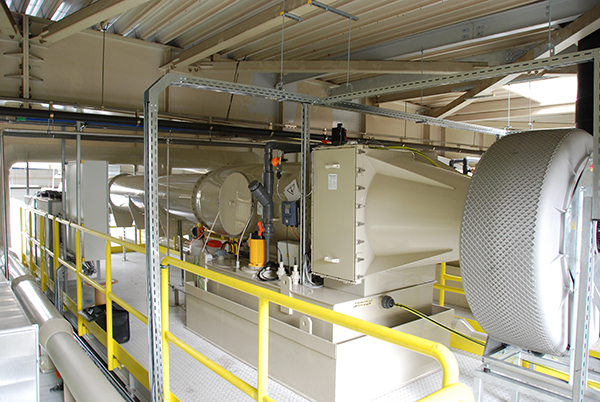
During the cleaning process inside the booth, contaminated, inorganic exhaust air is generated. To comply with the maximum permitted workplace air concentrations (MAK-values) and TA-Luft requirements, this air must be extracted and purified. For this purpose, two identical AIRTOP exhaust air scrubbers from Richard Tscherwitschke GmbH are used. Each scrubber is designed for an exhaust air volume of 10,000 m³/h.
The challenge was to achieve an optimal balance between sufficient purification performance—particularly with regard to exposure limits—and energy efficiency. To this end, energy consumption was calculated precisely based on the required exhaust air volume in the new booth. The contaminated air is now extracted over a large area above the process tanks and additionally captured laterally via extraction bars. Frequency‑controlled fans allow variable extraction performance, enabling the system to adapt to different operating conditions and reducing energy consumption.
Optimal Use of Limited Space
As this is a retrofit project, the available space must be utilized as efficiently as possible. To save space, the exhaust air scrubbers are installed between the booth and the hall roof. The horizontal design of the AIRTOP‑KS‑H scrubbers ensures a low installation height while maintaining optimal accessibility for maintenance personnel.
Air Exchange Cycle
The extracted exhaust air is routed from the booth roof to the respective scrubber. The purified air is then combined and discharged outdoors through a shared stack. To maintain the air exchange cycle, preheated fresh supply air is introduced into the booth.