Exhaust Air Purification in Cleanroom Technology
Daldrop + Dr. Ing. Huber designed and implemented the complete cleanroom technology for the laboratory processes of a manufacturer of medical isotopes and radiopharmaceuticals. The cleanroom installation covers an area of 200 m² and includes the supply and exhaust air systems. Various cleanroom modules are used, including double‑ and single‑skin cleanroom walls, a walkable cleanroom ceiling with fan filter units (FFUs), cleanroom LED lighting with service access from below, the supply and exhaust air system with glass return‑air ducts, the required cooling technology, and the building control room.
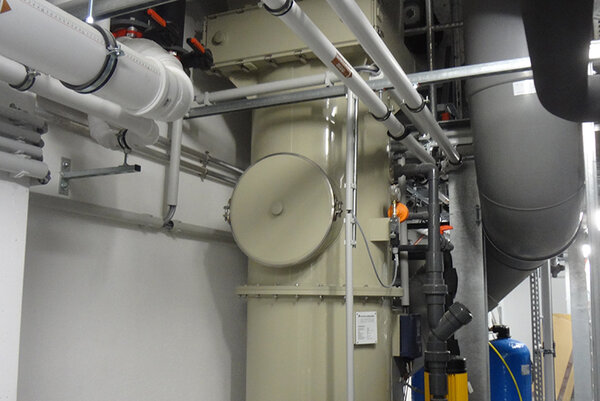
Vertically Installed AIRTOP Exhaust Air Scrubber
The contaminated process exhaust air from the laboratory processes is treated in a vertical AIRTOP KS‑V exhaust air scrubber equipped with a ZYKLOTOP® droplet separator from Richard Tscherwitschke GmbH.
During laboratory operation, exhaust air containing hydrochloric and nitric acid is generated. This air is captured directly within the laboratory workstations. A constant‑volume flow controller with motorized actuator regulates the process exhaust air to a defined volume flow. Depending on requirements, the extraction at individual laboratory workbenches can be switched on or off. The process exhaust air is then routed through the exhaust air system to the scrubber.
The AIRTOP KS‑V scrubber operates according to the cross‑flow scrubbing principle. The recirculated wash water is sprayed counter to the exhaust air stream via a nozzle system. Within the spray mist, the pollutants contained in the process exhaust air are absorbed on the large surface area of the water droplets. In the downstream ZYKLOTOP® droplet separator, entrained droplets are removed from the air stream. Due to the helix shaped channels of the ZYKLOTOP®, the pollutant‑laden droplets are deflected by more than 360°, resulting in a high separation efficiency and significant energy savings compared to conventional separation methods. The contaminated wash water is collected, neutralized with sodium hydroxide, and returned to the wash circuit.
Various sensors and control units monitor and regulate the exhaust air purification process: A submersible probe continuously measures the water level, while a pH probe monitors the pH value. If the pH exceeds a defined limit, the neutralizing agent is automatically dosed. Despite neutralization, pollutant concentration increases over time, requiring periodic desalination. A portion of the wash water is pumped out, sent to the water treatment system, and replaced with fresh water.
Fresh water must also be added periodically due to evaporation. The water level is monitored by a float switch. When replenishment is required, a solenoid valve opens the fresh‑water supply. Finally, the purified process exhaust air is discharged into the common exhaust duct system and then released outdoors above the roof.